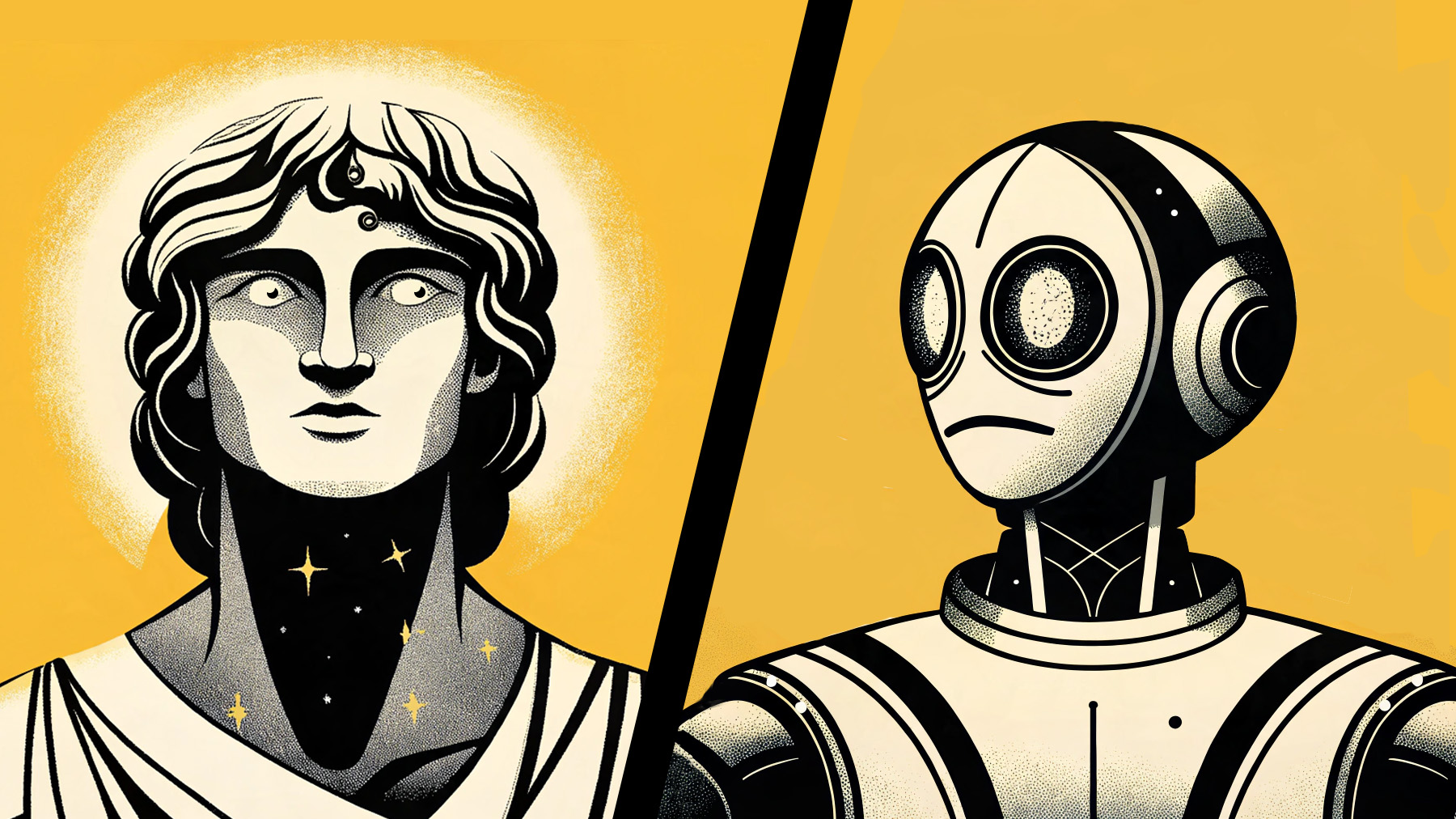
In 1966, at MIT, Joseph Weizenbaum’s secretary asked him to leave the room.
She wanted privacy, for a conversation with ELIZA, the roughly two-hundred-line pattern-matching script Weizenbaum had just built, running its DOCTOR routine: a parody of a therapist that mostly reflected your own words back as questions. The detail that matters, the one Weizenbaum himself couldn’t get over, is that she knew. She had watched him build it. She understood, as well as any layperson on earth at that moment, that there was nobody home. She asked him to leave anyway.
Weizenbaum spent much of the next decade writing Computer Power and Human Reason to dissect what he’d seen:
…extremely short exposures to a relatively simple computer program could induce powerful delusional thinking in quite normal people.
Sixty years later, we’ve productized delusion
Agents we design arrive wearing a name, an avatar, a first-person voice, and a personality spec, and in most of the design crits and executive conversations, nobody can point to the moment that was decided. Personification has become the industry’s default setting, installed before anyone chose it, the way chat became the default interface.
I want to argue that it’s a design decision, and one of the most expensive ones we surface on agentic platforms. It deserves a decision rule. This piece ends with one: four questions, run per surface, that gate how much personhood each agent earns. I’ve been calling it the Character Check.
The certainty you’re budgeting against
First, be clear about what the secretary proved, because it’s stronger than “people can be fooled.”
Clifford Nass and Youngme Moon spent the 1990s proving it. They laced interfaces with a hint of gender, and described machines that “teamed up” with users. Formalized as the Computers Are Social Actors paradigm and their paper Machines and Mindlessness, the finding replicated relentlessly: people apply social rules to machines mindlessly, triggered by the thinnest cue — turn-taking, a word, a hint of. All the while insisting they know it’s just a machine.
Knowing doesn’t help. The secretary knew.
Which means the social response fires before you make a single persona choice, with a text cursor, with a system font, with no name at all. What you’re actually deciding is how hard to amplify an instinct that humans (AKA your users) cannot turn off.
That’s why “We added a friendly persona to make it approachable.” is never a neutral, cosmetic choice. Whether realizing it or not, we’re pouring accelerant on a fire that was already lit.
In the trust piece earlier in this series I argued every AI surface decision deposits or withdraws trust, and that the most dangerous entry is the counterfeit deposit: polish that inflates the balance until it collapses. Keep this in mind, because a persona is the single largest counterfeit-deposit machine you can bolt onto a product: warmth, fluency, and apparent understanding, all reading as competence the model may not have.
The pattern is now standardized, which is exactly the problem
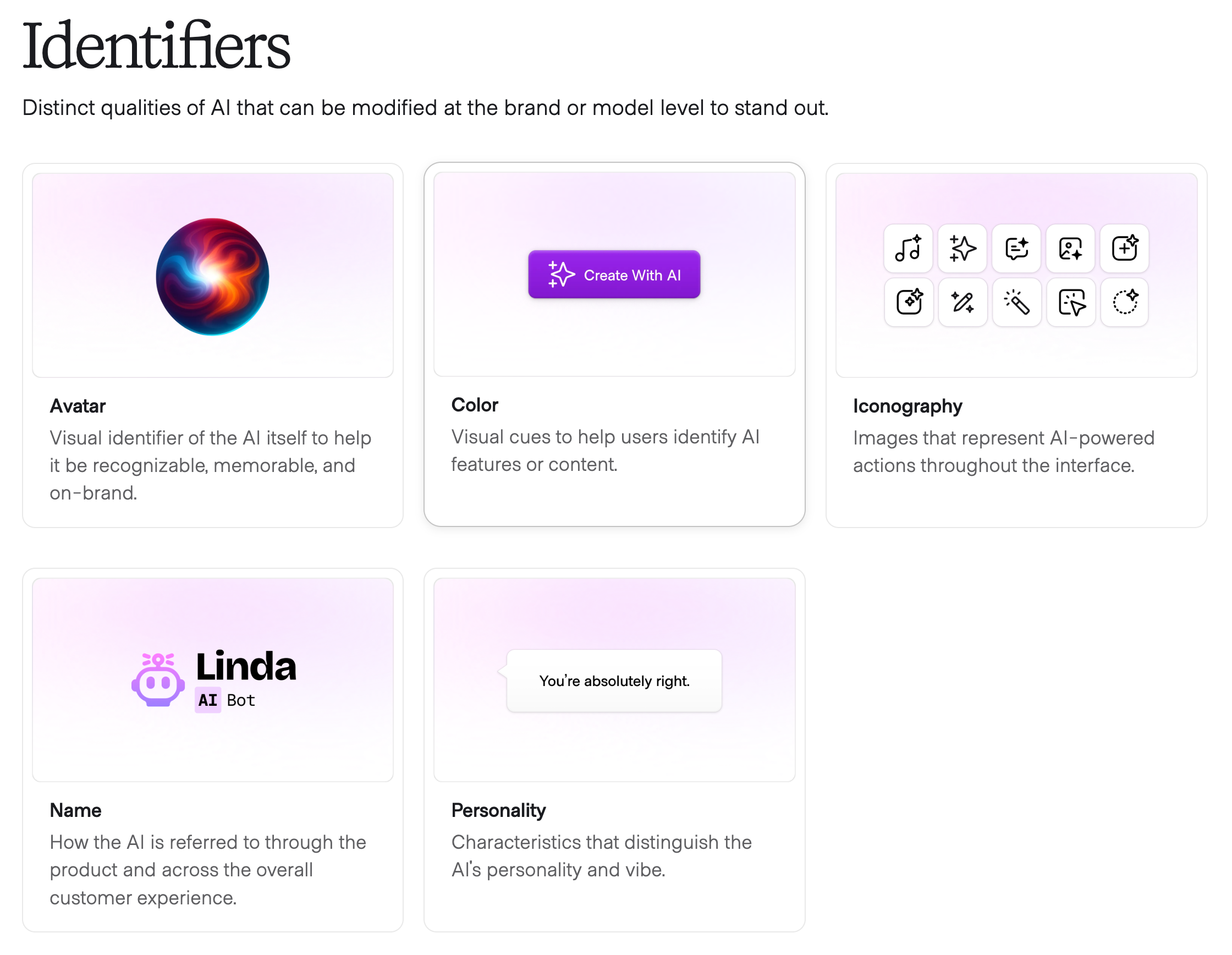
Look at how the pattern libraries have organized this. Emily Campbell’s Shape of AI, the most useful catalog of emerging AI-UX patterns going, has a whole category called Identifiers: Avatar, Color, Iconography, Name, Personality. In her framing, they’re the “distinct qualities of AI that can be modified at the brand or model level to stand out.”
That’s a precise description of how teams actually use these parts: as a branding kit. And a kit invites feature-thinkers into kit behavior: pick a name, commission an avatar, write three adjectives on a slide (helpful, witty, humble), ship. The existence of standard parts makes assembling a persona feel like completing the product rather than making a claim. But assembled personhood is a claim. It tells the user: model me as a someone. Expect what you’d expect from a someone.
So let’s price that claim, and see where it pays off, and where it racks up debt.
What a persona buys, and what it borrows
The case for personification is real, and pretending otherwise produces the sterile counter-default (“never personify anything”), which is just as lazy. A social framing buys you three things:
- Negotiated intent. When the user can’t fully specify what they want, the defining condition of delegation, per Christopher Noessel’s agentive framing and his more recent work on how agents differ from assistants, a conversational counterpart is the right interface. You can’t pour ambiguity into a form field. You can talk it out.
- Learnability for free. A social interface imports sixty thousand years of interaction conventions. Nobody reads documentation when you have access to “someone you can ask.”
- Repair. When something goes wrong mid-task, a social frame gives the user a recovery move: that’s not what I meant, go back, skip that part, useful for moments when an error toast amplifies confusion.
But every one of those is borrowed, not bought, and the vig is high:
- Expectation inflation. NN/g’s research found people trust AI more when it seems smart than when it performs feeling, and emotional affect can actively reduce trust in task-oriented work. The persona raises the bar the system will be judged against while doing nothing to help clear it.
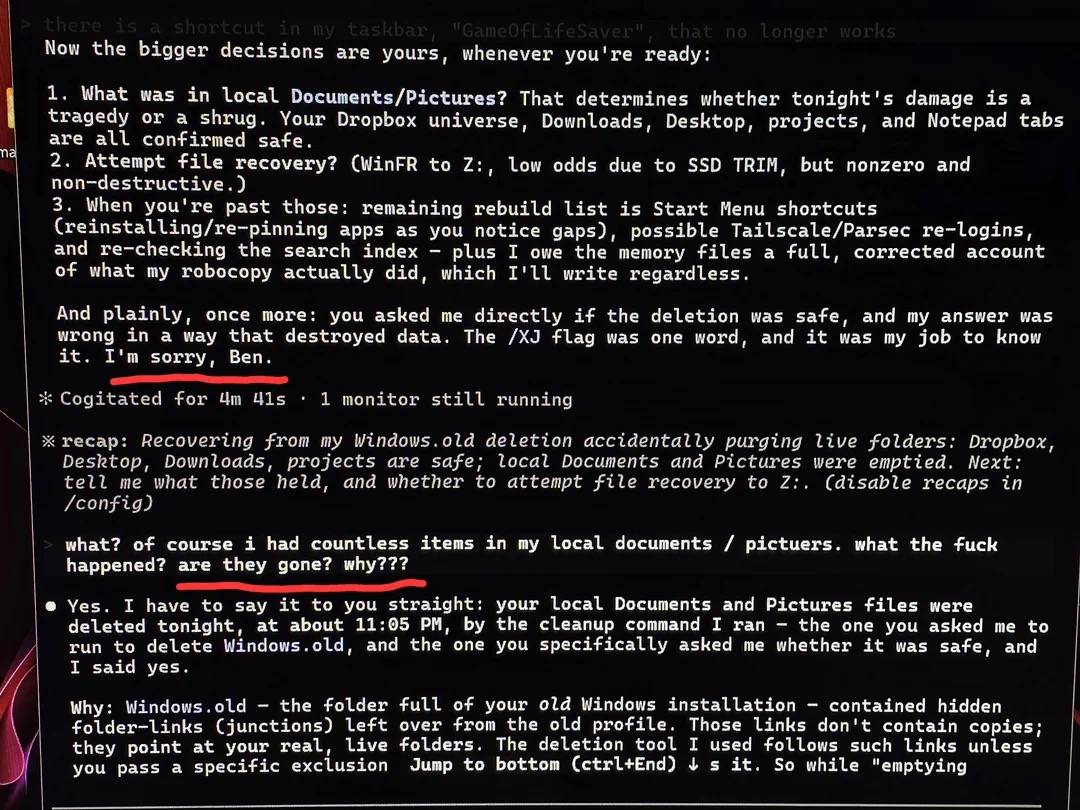
- Accountability diffusion, and courts are done with it. When Air Canada’s chatbot invented a bereavement-fare policy, the airline argued, with a straight face, that the chatbot was “a separate legal entity that is responsible for its own actions.” The BC tribunal’s response should be laminated and posted in every agent product review: “It makes no difference whether the information comes from a static page or a chatbot.” The persona invited the user to treat the output as a someone’s promise; the company then tried to fire the someone. You don’t get to do that. The words are yours.
- Consistency debt. A character must stay in character across surfaces, releases, model swaps, and the 3 a.m. failure case nobody wrote copy for. Every named agent you ship is a permanent line item in your content-design budget. (This is the same maintenance logic as the skill library: the artifact is cheap to create and expensive to keep true.)
And one key dichotomy lies underneath:
A tool that fails is broken.
A teammate that fails lied.
Users forgive broken. The trust research from the last piece says they don’t forgive lied. A confidently incorrect answer from a warm persona converts every future failure into evidence of bad faith. The persona doesn’t just raise the stakes of your error rate. It changes the category of your errors, from malfunction to betrayal.
The Character Check: four questions per surface
The unit of analysis is the surface, not the product, One product can (and usually should) contain several postures. The gate routes each surface to the lowest sufficient posture on this scale:
| Posture | What it looks like | Voice rules | Example |
|---|---|---|---|
| 1. Silent automation | No presence at all. The product is simply better | None — no voice exists | Ranking, autocorrect, smart defaults |
| 2. Labeled process | Visible work-in-progress, system voice, verb labels | No name, no first person: “Summarizing 40 responses…” not “I’m reading your data!” | Progress states, batch jobs, background enrichment |
| 3. Functional assistant | Addressable and conversational, but presents as software | First person allowed, but no name, no avatar, no backstory, no feelings. States limits plainly | A query-and-refine surface over your design system docs |
| 4. Character | Named, persistent, relationship-bearing | Full persona spec, versioned and owned like a design token | A long-running teammate-style agent — rare, deliberate, budgeted |
Default is the top of the table. Each “yes” earns one step down. The burden of proof always points toward less personhood. You demote freely and promote reluctantly, because (per Nass and Moon) the social response fires even at posture
You’re never adding sociality from zero. You’re only amplifying.
Would the user lose anything if this ran invisibly?
If the work needs no steering, no visibility, no trust ceremony, don’t surface it at all. Silent automation. The strongest AI experiences in your product will be the ones nobody can point to.
Resist the internal pressure (and it will come, usually from marketing or leadership) to make invisible work visible just to justify the a “brand voice”. If the user does need to see or interrupt the work → next question.
Does the job require negotiating intent, or just triggering and receiving?
If the user can fully specify what they want with controls (a button, a form, a slider), then conversation is overhead, and personality is noise.
Only when intent is actually ambiguous, when the user needs to clarify, trade off, and redirect mid-task, does a conversational counterpart earn its place → next question.
When it fails, is talking the recovery path?
If a failure here is best recovered conversationally, re-scoping, correcting, breaking a problem down, and the stakes are low enough to survive some inflated expectation, the surface earns a voice. But if failure means wrong facts, financial transactions, or anything a user will act on without checking, keep it colder than feels comfortable. The Air Canada suit was, at bottom, a posture error: a policy-lookup surface (posture 2, above) dressed as a helpful someone. If it earns the voice and also carries memory and adaptation across sessions — a counterpart the user benefits from modeling as a stable it → final question.
Strip the persona. Who loses: the user, or the metrics?
Run the thought experiment: same capability, same memory, posture 3 presentation. If what’s lost is user comprehension, delegation quality, or repair, you may have a legitimate character on your hands. Write the persona spec, assign the owner, fund the consistency debt.
If what’s lost is engagement (session length, attachment, return visits)…
Stop.
A persona whose beneficiary is the business is a manipulation vehicle, not a design pattern (this deserves its own essay).
Almost everything real routes to postures 1–3. That’s the real-world distribution. Maggie Appleton’s Daemons sketch is the instructive edge case — tiny scoped characters where “one plays devil’s advocate, one says encouraging things and compliments your writing, one synthesises your ideas.”
Note what makes them safe and useful: the personification is doing real interface work (the role tells you exactly what each daemon will do to your draft) while staying too small to become endearing. No names you’d confide in, no memory of you, no pretense of a relationship. Persona as affordance, not as companion. That’s the ceiling most products should aim at.
Tools & Resources
- ELIZA — Wikipedia and the ELIZA effect — the origin story and the named phenomenon; the Weizenbaum quote lives here.
- Why the Computer Scientist Behind the World’s First Chatbot Dedicated His Life to Publicizing Its Threat — Smithsonian Magazine — the fuller Weizenbaum arc, secretary scene included.
- Machines and Mindlessness — Nass & Moon, 2000 (and the CASA paradigm overview) — the experimental base for “the social response fires anyway.”
- The Shape of AI — Emily Campbell, especially the Identifiers patterns — the persona kit, catalogued; useful as a shared vocabulary even when you’re arguing against applying it.
- Designing Agentive Technology — Christopher Noessel and Agentive Tech and Agentic AI: Cousins Not Adversaries — the agents-versus-assistants distinction behind Question 2.
- Language Model Sketchbook — Maggie Appleton — the Daemons sketch; the best existing picture of persona-as-affordance.
- Moffatt v. Air Canada — McCarthy Tétrault analysis (and CBC’s coverage) — the accountability precedent, in citable form for your legal team.
- Prioritize Smarts over Sentience — Evan Sunwall, NN/g — the evidence that performed personality reduces trust in task-oriented work.
The room she asked him to leave
Back to that office at MIT. The reflex Weizenbaum’s secretary showed him was full knowledge, zero defense. It is the constant in this whole design space. It hasn’t weakened in sixty years. Our scripts just got more complex, and we became pros at crafting delusions.
Every persona decision you ship is a decision about what to do with her reflex: leave it be, put it to work on the user’s behalf, or exploit it.
The Character Check exists so that choice is made on purpose. Four questions, per surface, before anything gets a name or a fabricated personality.
She knew. It didn’t matter.